Off-the-Shelf vs Custom Software, When Building Is the Right Call

The benefits of custom software development are real, but they pay off only under a narrow set of conditions. Buy off the shelf when the process is standard and a mature product already handles it. Build when the process is your competitive advantage, when the integration depth you need exceeds what the platform exposes, or when per-seat licence costs are compounding past what a build and its running costs would total.
For most businesses, most of the time, buying is the correct call. This article identifies the exceptions.
Treat this as a build vs buy software decision rather than a list of reasons to build. The question is not whether custom software can fit your process better. It always can. The question is whether that better fit is worth the money, the time and the maintenance years that follow.
Why buying is the right default for most businesses
A mature product has absorbed years of edge cases you have not thought of yet. It has been through security reviews, penetration tests, compliance renewals and the awkward failures that only surface at scale. A first custom release has none of that history.
Time to value is the second reason. A configured product can be running in weeks. A build takes months, and the first months produce nothing the business can use.
The third reason matters most to operations and enterprise buyers. The vendor carries the patching schedule, the uptime commitment and the feature roadmap. Somebody else is on call at 2 am. Somebody else maintains the certifications your procurement team asks about. That is a genuine transfer of risk, and it usually comes at a price lower than carrying the risk yourself.
If a mature product covers 80 per cent of your process and the remaining 20 per cent is not where you compete, buy the product and adapt the process. Changing how you work is cheaper than building software to preserve a habit.
Six signals that a custom build is justified
These are the conditions where the advantages of custom software outweigh the cost and the risk. One signal alone is rarely enough. Two or three together usually means the answer is build.
The process is a differentiator, not a commodity: Customers notice how you do it, and it is part of why they choose you. No vendor roadmap will prioritise your particular way of working, because you are one account among thousands.
Per-seat licence costs are scaling past a build: Subscription pricing grows with headcount. If you are adding 30 people a year to a system priced per user, the licence line compounds while a build cost does not.
The business runs on spreadsheets glued around a product that doesn't fit: manual re-keying, exported CSVs, a shared drive of workbooks that one person understands. That labour is a cost, and it is usually invisible until someone measures it.
Integration requirements exceed what the platform supports: An API (application programming interface, the defined way one system exchanges data with another) only lets you do what the vendor chose to expose. If you need to connect a legacy ERP, a finance ledger, a practice management system, Australian payment and banking rails or government digital services, the vendor's API often stops short. When the starting point is replacing or extending an established system, this becomes enterprise software development rather than a straight product swap.
Data residency or handling obligations rule the vendor out: Under the Australian Privacy Principles in the Privacy Act 1988, APP 8 governs cross-border disclosure of personal information and APP 11 governs the security of that information. The APPs are principles-based rather than a prescriptive rule set, so the obligation sits with your business regardless of where a SaaS vendor stores the data. If you can't feel confident in a vendor's handling, building gives you control over where data lives and who can access it.
The workflow spans systems no single product covers: The value sits in the orchestration layer, not in any one function. Nobody sells that layer because it depends on how your systems are arranged.
Four counter-signals that say buy, not build
These carry the same weight as the six above. If any one of them is true, pause the build conversation.
The process is standard, and a product already handles it well: Payroll, general ledger, helpdesk ticketing, CRM basics. Different isn't better, and rebuilding a commodity is how budgets disappear.
No named internal owner after launch: Software without an owner decays no matter who builds it. Somebody has to hold the backlog, approve trade-offs and decide what gets fixed first. If you cannot name that person before you start, you are not ready.
A timeline shorter than a build allows: A contract renewal, a compliance date, a merger cutover. When the date is fixed and close, configure and integrate. Build later if the fit still hurts.
A budget that covers the build but not the following three years: Hosting, patching, dependency upgrades, support and the feature work the business will inevitably ask for. A build funded to launch and no further becomes a liability in year two.
The middle path, configure the product and build the integration layer
There is a middle path, and in our experience of discovery conversations it is the right answer more often than either extreme. Keep the off-the-shelf product for the commodity work, then build a thin custom layer that joins it to the systems it cannot reach. The custom code handles integration, orchestration and the parts of the process that are genuinely yours. Everything else stays the vendor's problem, including the patching and the certifications. In practice that might mean keeping a mature CRM for pipeline while a custom layer joins it to a legacy ERP and Australian payment rails.
How custom and off-the-shelf compare, side by side
The two options fail in opposite directions. Off-the-shelf is cheap to start and expensive to scale; custom is expensive to start but cheaper to maintain if the process stays stable.
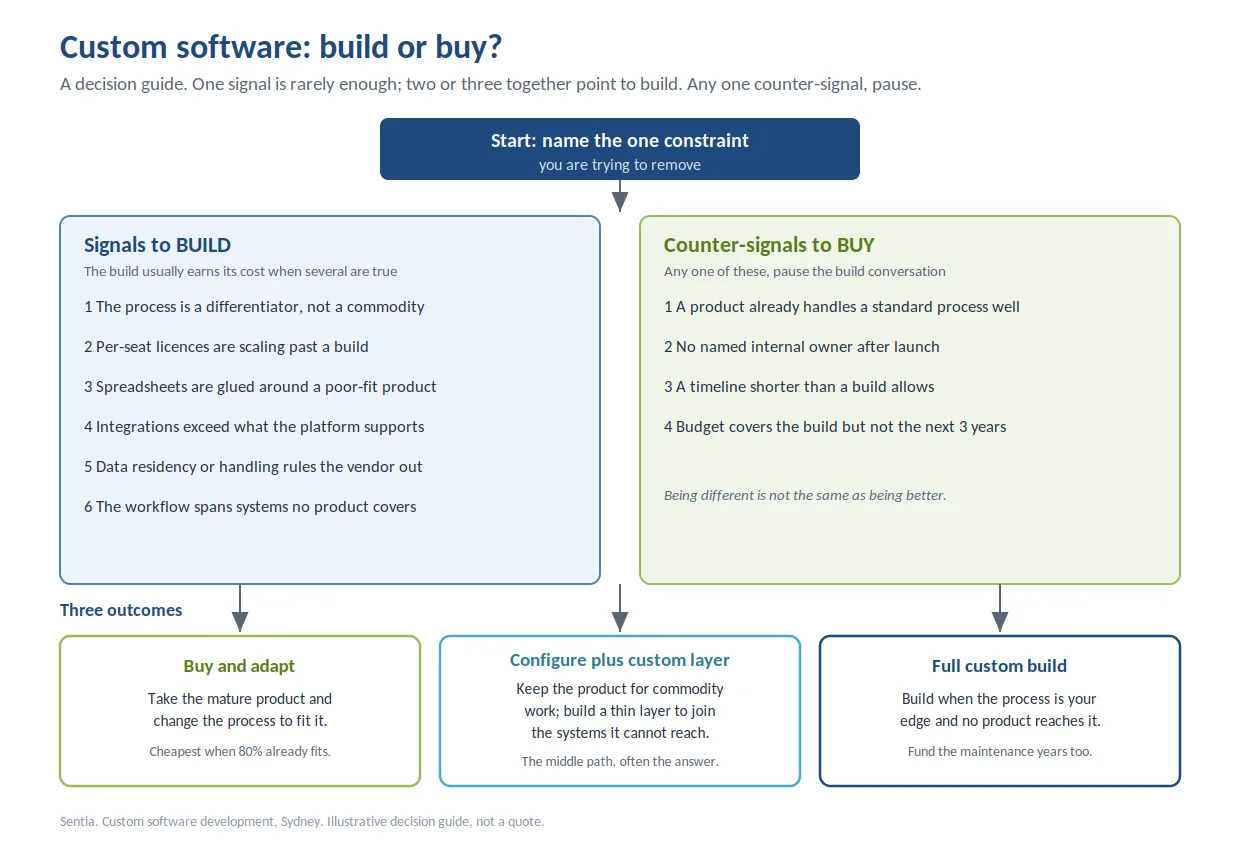
Figure 1. Build or buy, a decision guide. Illustrative, not a quote.
Factor | Off-the-shelf (configured) | Custom build |
|---|---|---|
Upfront cost | Low. Configuration and data migration only. Indicative AUD 15,000 to 80,000 as at 2025 for a mid-market rollout including consulting and migration, excluding licences | Front-loaded capital cost. Indicative AUD 150,000 to 600,000 as at 2025 for a scoped first release delivered by a local senior team of three to five, excluding hardware, data migration and third-party licences |
Ongoing cost | Recurring per-seat licence. Indicative AUD 600 to 2,400 per user per year as at 2025 for a mid-market operations product, scaling with headcount and tier | Recurring run cost: hosting, monitoring, patching and support. Does not scale with headcount |
Time to value | Weeks to a few months | Months to a first usable release, longer for full scope |
Fit to process | Good for standard processes, poor where you are genuinely different | Exact by definition, and exactly as good as the discovery behind it |
Integration flexibility | Limited to the APIs and connectors the vendor exposes, some of them paid | Limited only by what the systems on either end allow |
Vendor lock-in | High. Data models, workflows and pricing tiers are the vendor's | Low, provided you own the code and the repositories |
Maintenance burden | Carried by the vendor | Carried by you or your delivery partner |
Table 1. Off-the-shelf versus custom software, indicative AUD costs and trade-offs, as at 2025.
Every figure above is an illustrative range with the assumptions stated, not a quote. Read the table as a shape rather than a price list: the licence column grows with your headcount, the build column grows with your ambition.
Total cost of ownership over three to five years
Custom software costs don't stop at launch. Budget for hosting, monitoring, security patching, dependency and framework upgrades, support, and the feature work the business will ask for once people start using the thing. As a planning assumption, expect annual maintenance in the range of 15 to 25 per cent of the original build cost, as at 2025, for a system in active use with a modest change appetite. That range moves with how many integrations you carry and how fast your dependencies move.
Off-the-shelf cost compounds differently. Per-seat licences grow with headcount. Tier upgrades arrive when you cross a usage threshold you did not know existed. You add paid connectors one at a time. Then there is the labour cost of the workarounds a poor fit forces on your team, which never appears on an invoice.
The crossover point is not a number. It depends on four things: how fast headcount is growing, how the licence tiers are structured, how much manual work the poor fit creates each week, and how long the process stays stable enough to be worth encoding.
Two risks belong on the custom side of the ledger. Key-person risk, where one developer holds the context. And technical debt, where deferred upgrades quietly raise the cost of every future change.
Sentia has been building and maintaining software since 2006, and the pattern is consistent: the maintenance years decide whether a custom build was worth it, not the build months.
What goes wrong when businesses build too early
These are the failure modes we see most often, including in project rescue work where we inherit a codebase somebody else started.
Building before the process is stable. You encode this quarter's workflow into software, then pay to change it next quarter when the workflow moves. If the process is still being argued about in meetings, it is not ready to be software.
Building something that already exists. This usually happens because nobody stress-tested the off-the-shelf option properly. A two-week evaluation with real data and real users would have settled it. A demo does not count.
No named internal owner. Decisions stall, the backlog drifts toward whoever shouts loudest, and adoption never happens because nobody is accountable for it. This is the single most reliable predictor of a disappointing build.
Scope set by a wish list. Someone circulates a document, everyone adds their feature, and the first release tries to serve it all. The fix is blunt. Write down the one constraint that triggered the decision to build. Cut anything in scope that does not serve it. Add the rest later, from evidence.
What a custom build actually involves
Knowing when to build custom software is one thing. Knowing what you are signing up for is another. The stages below are what the commitment actually looks like.
Discovery and process mapping come first. You walk the current process end to end, including the spreadsheets, and you write down the constraint the build must remove. Scoped delivery follows, and this is where most of the value in custom software development sydney engagements is decided, because a backlog tied to one constraint stays affordable while a backlog tied to a wish list does not.
Then staged delivery. You aim for an MVP (minimum viable product, the smallest version that solves the constraint in production, not a demo), then extend it. Architecture decisions in that first release set the ceiling for everything after, so you plan for scale from the start. Our team has built web applications serving 15 million or more users, and that experience is mostly about what you decide in month two.
Handover matters more than it sounds. Documentation, repository access, deployment credentials, environment configuration. If you cannot hand the system to a different team, you do not really own it.
Then support. This is a multi-year relationship with a codebase, not a one-off project. Choose a delivery partner based on that.
Frequently Asked Questions
- Is custom software more expensive than off-the-shelf?
- Usually more upfront, sometimes less over three to five years. The deciding drivers are headcount growth and licence tier structure. If your user count is flat, subscriptions stay cheaper. If you are adding people quickly on a per-seat product, the licence line compounds while a build cost does not.
- How long does a custom software build take?
- As a planning range in 2025, a first usable release commonly lands somewhere between three and six months, with full scope often nine to eighteen. Those assume a scoped backlog, an available internal owner and no mid-project scope reset. Treat them as ranges, not commitments.
- Can we start with off-the-shelf and move to custom later?
- Yes, and it is often the sensible sequence. Buying first teaches you what the process actually needs. Two conditions apply: keep your data exportable in a usable format, and avoid deep proprietary customisation inside the vendor's platform, because that work does not migrate.
- Who owns the code in a custom software build?
- The client should own the intellectual property, the repositories and the deployment infrastructure. Settle this in the contract before work starts, not at handover. Without written ownership and access, you have bought a dependency rather than an asset, whatever the invoice says.
- Is bespoke software the same decision as build versus buy?
- In Australian usage, bespoke software and custom software mean the same thing, software built for your process rather than bought off the shelf. The decision framework is identical. Weigh the same signals and counter-signals, and fund the same maintenance years, whichever word your team happens to use.
Deciding your next step
The test is three questions. Name the constraint you are trying to remove. Check whether a mature product already handles it well enough that adapting your process would be cheaper. Then check whether you can fund the maintenance years, not just the build.
If the signals point to building, our guide to custom software development walks through the process, from discovery to ongoing support. The next question is usually who should build it: agency, in-house or freelancers.
Working out whether to build or buy?
That is the conversation Sentia has been having with Australian businesses since 2006. See how we approach custom software development in Sydney, or tell us the one constraint you are trying to remove, and we will tell you honestly whether a build is the right call.