Vibe Coding Review: Auditing Your AI-Built App

You described what you wanted, an AI tool wrote the code, and the app works. Now it is about to take real customers, payments and data, and a quieter question has surfaced. Is any of it actually safe to run? Speed was the whole point of building this way, but nobody checked the parts that only bite under load, under attack, or under the next six months of change.
A vibe coding review answers that before your users do, and this guide covers what it looks at, what it costs and how long it takes in Australia, and how to read the verdict, whether your app needs targeted fixes, scoped remediation or a rebuild.
What is a vibe coding review?
A vibe coding review is a structured, fixed-scope audit of an application built largely by AI, covering its security, data handling, architecture, test coverage and maintainability. It ends with a written verdict on one question: can the app be run and extended safely, or does part of it need rebuilding?
Vibe coding means describing what you want in natural language and letting an AI tool generate the working code. Most AI-built apps that later need a review were produced this way in tools such as Cursor, Lovable, Replit, Bolt and v0, where the output runs, the demo lands, and the app goes live faster than anyone expected.
The label itself is fragile. Andrej Karpathy, who coined "vibe coding" in February 2025, called the term passe in February 2026 in favour of "agentic engineering". The naming will keep moving, but the underlying issue does not. What matters is the quality and security of code that a human did not write line by line.
So a vibe coding review applies whether the work was called vibe coding, agentic engineering or just development. The question is the same. What is actually in the repository, and what happens when a real customer uses it?
Why AI-built apps fail in predictable ways
AI-generated code fails along a narrow set of repeating patterns, not randomly. That's why an audit can be structured rather than exploratory. You know most of what you are looking for before you open the codebase.
The characteristic failures:
Plausible-looking code that compiles and demos well but carries injection and authentication flaws. Output that is almost right but not quite was the single biggest developer frustration in the Stack Overflow 2025 Developer Survey, cited by 66 percent of respondents.
Missing input validation on anything a user can type into
Credentials and API (application programming interface) keys committed straight into the repository
Absent or superficial test coverage, often tests that assert the code does what the code does
Architecture that carries the MVP (minimum viable product) but cannot absorb the next feature
The mechanism is simple. Generative tools optimise for code that looks correct and runs. They do not optimise for code that holds under hostile input, or under a year of feature additions by people who were not there at the start.
The evidence backs the pattern. The Stack Overflow 2025 Developer Survey, with more than 49,000 responses, found 84 percent of developers now use or plan to use AI coding tools, while trust in the accuracy of that output fell to 29 percent, down from 40 percent a year earlier. On code volume, New Relic's 2026 State of AI Coding report puts GitHub Copilot's share of accepted code at 46 percent across its user base, with 67 percent of surveyed technology leaders saying AI now generates or significantly refactors more than half of their code.
On security, Veracode's 2025 GenAI Code Security Report, which tested more than 100 large language models across 80 coding tasks, found 45 per cent of AI-generated samples introduced an OWASP Top 10 (Open Web Application Security Project) vulnerability, a failure rate its March 2026 update reported as essentially unchanged.
Enterprise data points the same way. Apiiro's analysis of Fortune 50 codebases found AI-assisted developers ship three to four times more commits than their peers, while security findings pile up far faster than human-only teams generate them.
None of that argues against AI tools. AI-assisted development is now standard practice, and the AI code quality problem is a governance problem, not a tooling problem.
The question is not whether AI wrote the code. It is whether anything checked it before it shipped.
Five signs your app needs a review now
Most founders do not need an audit on a schedule. They need one when a specific trigger appears, and the checklist below is the fastest way to tell whether you need one right now.
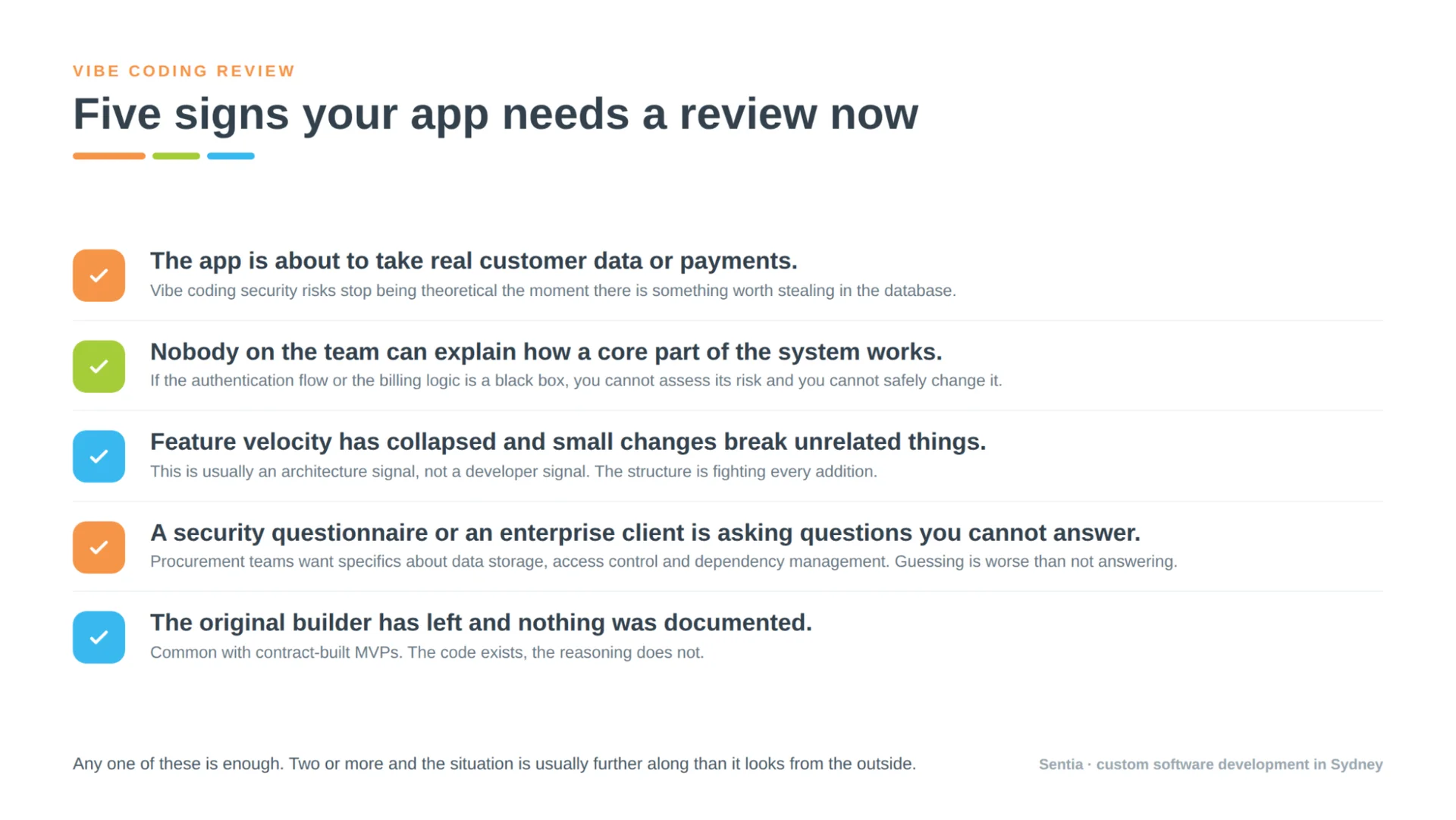
Each trigger matters on its own, because it doesn't always show up for the first reason. Here is what each one signals.
The app is about to take real customer data or payments: Vibe coding security risks stop being theoretical the moment the database has something worth stealing.
Nobody on the team can explain how a core part of the system works: If the authentication flow or the billing logic is a black box, you cannot assess its risk, and you cannot safely change it.
Feature velocity has collapsed, and small changes break unrelated things: This is usually an architecture signal, not a developer signal. The structure is fighting every addition.
A security questionnaire or an enterprise client is asking questions you cannot answer: Procurement teams want specifics about data storage, access control and dependency management. Guessing is worse than not answering.
The original builder has left, and nothing was documented: Common with contract-built MVPs. The code exists, the reasoning does not.
Any one of these is enough. Two or more, and the situation is usually further along than it looks from the outside.
The cost of a review rises sharply once real customer data is in the system, because remediation then has to happen without downtime, data loss, or breaking anyone's live account.
What a vibe coding review actually covers
A vibe coding review is a fixed-scope audit that produces a written report. It is not an open-ended engagement, and it is not a discovery phase that quietly turns into a build. At Sentia, we set the scope before the work starts.
The scope:
Security and dependency audit: Committed credentials, authentication and session handling, input validation, injection surfaces, and known vulnerable packages in the dependency tree.
Data handling and exposure: What personal information the app collects, where it sits, who can reach it, and how that stacks up against the Australian Privacy Principles. If an eligible data breach later occurs, the Notifiable Data Breaches scheme requires you to notify affected individuals and the OAIC, so the review flags where you would be exposed. Relevant to any app collecting customer data in Australia.
Architecture and scalability: Whether the current structure can carry the next twelve months of features, and where it will bind first.
Test coverage and CI/CD state: What is tested, what is asserted, and whether continuous integration and continuous delivery (CI/CD) pipelines exist and actually block bad builds.
Documentation and handover readiness: Can a new developer be productive, and how long would that take?
Remediation effort estimate in days: Per finding, not as a lump sum.
At the end, you receive a prioritised findings list, a severity rating against each finding, and an effort estimate. That document is yours. You can hand it to your team, a freelancer, or another agency for a second opinion. An AI-generated code review is only useful if it is portable.
To start a review, Sentia needs a few things from you:
Read access to the repository, including full commit history.
Access to a working deployment or a staging environment.
Read access to the cloud and database consoles the app runs on.
Any existing documentation, architecture notes, or the original builder’s contact where possible.
A mutual non-disclosure agreement (NDA), signed before anyone looks at your code.
The three outcomes of a review
There are three honest outcomes, and a competent reviewer will tell you which one you have before you spend anything on fixing. Sentia has been building custom software in Sydney since 2006, and over twenty years, the judgement that matters most is not "is this code good" but "can this code be changed safely by someone who did not write it".
One recent review makes the point. On a booking platform about to take its first paying customers, we found the payment provider's secret key committed into the front-end bundle and no server-side validation on the checkout endpoint. Moving that key into a managed store, adding validation, and building a test suite around the payment path took four days, and the rest of the codebase held.
Outcome one: the app is sound and needs targeted fixes. Usually, credentials are moved to a managed store, input validation is added at the boundaries, and a test suite is built around the paths that carry money or personal data.
Outcome two: significant remediation is needed, but the foundation holds. The data model is sensible, and the business logic works. The work gets scoped, sequenced and done in order of severity.
Outcome three: a rebuild of some or all of it is faster and cheaper. Sometimes true, sometimes not. The deciding factors are how much of the data model is salvageable, whether the architecture can carry the next twelve months, how much working business logic already exists, and whether anyone understands the current system well enough to remediate it safely. If nobody does, remediation costs more than replacement. Rescue and remediation of AI-generated codebases has become a recognised service category across 2025 and 2026 for exactly this reason. If the review points to a rebuild, project rescue is the next conversation.
Those factors are easier to weigh as a sequence than as a list. The diagram below walks the same four questions in order, from the data model up to whether anyone still understands the system, and shows where each answer sends you.
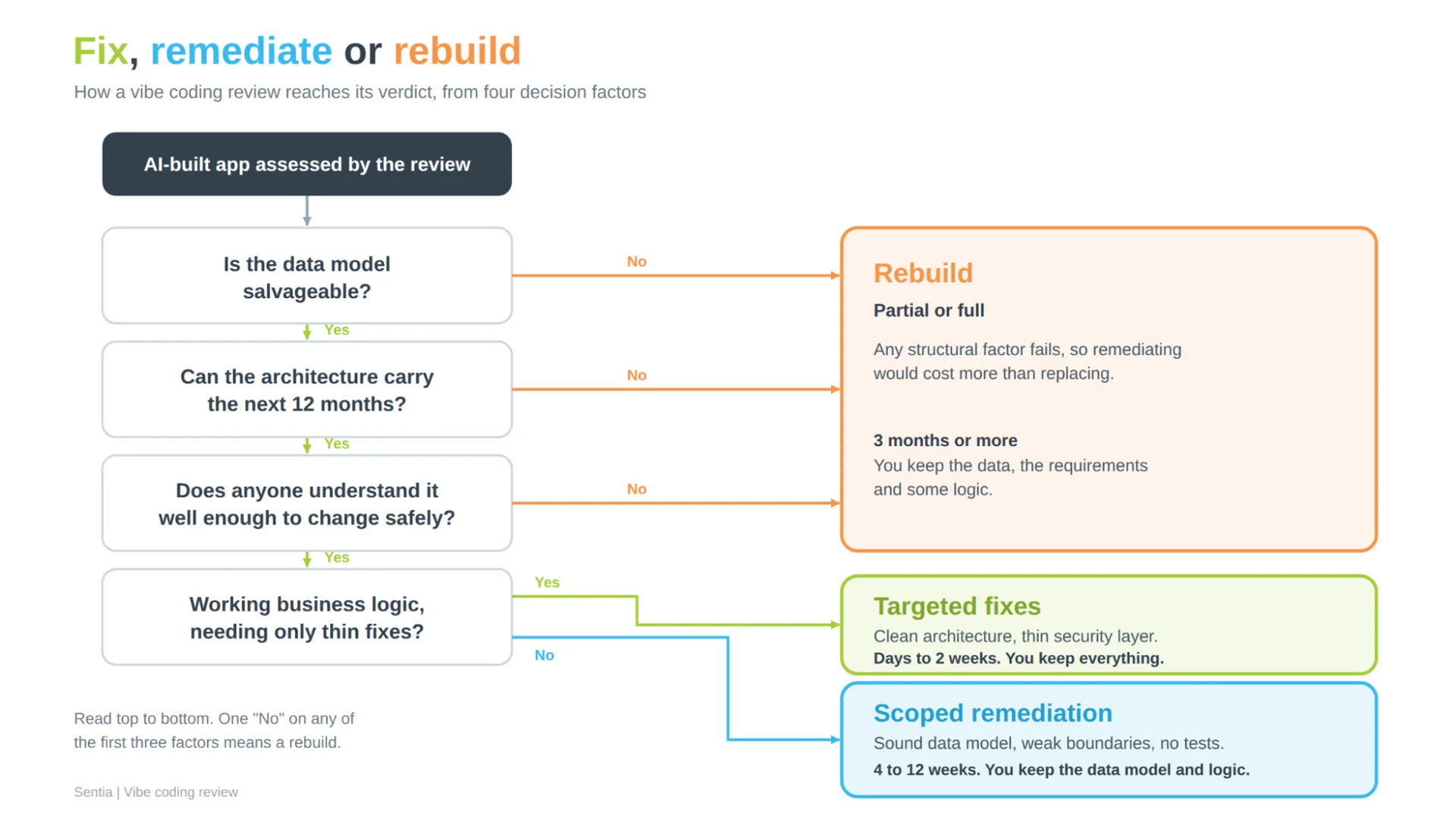
Where you land is only half the answer. The table below puts rough numbers against each path, so you can see the likely effort and what survives before any work starts.
Outcome | Typical trigger | Typical effort band | What you keep |
|---|---|---|---|
Targeted fixes | Clean architecture, thin security layer | Days to two weeks | Everything |
Scoped remediation | Sound data model, weak boundaries and no tests | Four to twelve weeks | Data model, business logic |
Partial or full rebuild | Architecture blocks the roadmap, no one understands it | Three months or more | Data, requirements, some logic |
What a review costs and how long it takes
For a small to mid-sized application, expect a review to take one to three weeks. Two profiles cover most engagements.
Application profile | Indicative range (AUD) | Typical duration |
|---|---|---|
Single-service app, no live customer data | $8,000 to $15,000 | 1 to 2 weeks |
Multi-service app, already in production | $15,000 to $30,000 | 2 to 3 weeks |
As at early 2026, these are indicative bands, not quotes. Scope is confirmed after a short discovery conversation, and the figures assume repository access and a working deployment.
Three variables move the number:
Codebase size. Lines of code and the number of separate services or repositories.
Live customer data. A production app carries privacy and downtime considerations a staging app does not.
Available context. Whether documentation exists, or the original builder is reachable.
What happens after the review
The report is the decision point. What follows is ordinary software engineering with a clear backlog, which is a better starting point than most AI-built app problems.
The remediation sequence rarely changes. Close security findings first, starting with anything exposing credentials or customer data. Add test coverage around the parts you intend to keep, so the next change does not undo the last fix. Then restructure the architecture ahead of the next feature set, not after it.
You can take the report to your own team or to any developer you like. The review holds its value regardless of who does the work. If you want Sentia to do it, remediation is staffed the way we staff everything else, senior people in Sydney setting direction and nearshore engineering in Zagreb doing sustained build work. Talk to our Sydney team about scoping the remediation work through our custom software development in Sydney.
If your app is about to take customer data and nobody can fully explain how it works, a vibe coding review gives you a written answer in a few weeks. Ask us what a review of your codebase would involve.
How to avoid needing a review in the first place
The governance layer costs very little to add early and is expensive to retrofit. Four practices cover most of it.
A human makes the architectural decisions before any code is generated: Data model, service boundaries, authentication approach. Generation is fast at filling in a structure and poor at choosing one.
Every piece of generated code passes a review gate before it merges: A named person, a pull request, and a rule that nothing reaches the main branch unreviewed. This is the single highest-value control.
Test coverage starts with the first feature, not after launch: Tests written later are written to pass, not to catch. Tests written alongside the feature encode what the feature is supposed to do.
Secrets and credentials live in a managed store, never in the repository: Environment-level secret management from day one, because removing a committed key from git history is far harder than never committing it.
None of this is an argument against building with AI. Your app developers should be using these tools. The governance sits around the output, not against it.
Frequently Asked Questions
- Are AI-built apps safe to use in production?
- Some are, many are not, and the difference is governance rather than the tool used. Veracode's 2025 GenAI Code Security Report tested more than 100 large language models and found 45 percent of AI-generated code samples introduced an OWASP Top 10 vulnerability, a rate its March 2026 update found had not improved. An audit before you take customer data settles the question for your specific app.
- How is a vibe coding review different from a normal code review?
- A normal code review checks a single change before it merges. A vibe coding review audits an entire existing codebase against known AI failure patterns: committed credentials, missing input validation, superficial tests, and architecture that cannot carry the roadmap. It produces a prioritised written report, not inline comments.
- Should I fix my AI-built app or rebuild it?
- It depends on four things: how much of the data model is salvageable, whether the architecture can carry the next twelve months of features, how much working business logic exists, and whether anyone understands the system well enough to change it safely. If nobody does, rebuilding is often cheaper.
- How long does a vibe coding review take?
- For a small to mid-sized application, typically one to three weeks. Codebase size, the number of separate services, whether the app is already live with customer data, and the availability of documentation or the original builder all affect the timeline. Scope is confirmed after a short discovery conversation.
- Is a vibe coding review the same as a penetration test?
- No. A penetration test attacks the running application from the outside to find exploitable weaknesses. A vibe coding review reads the source, dependencies, tests and architecture from the inside. The two are complementary, and the review usually comes first, so you fix the obvious structural flaws before paying to attack what remains.
Book a Vibe Coding Review
Sentia is a custom software development company in Sydney, building web, mobile and AI applications since 2006. If your AI-built app is about to take customer data and nobody can fully explain how it works, talk to our Sydney team about scoping a vibe coding review of your codebase. Book a review.